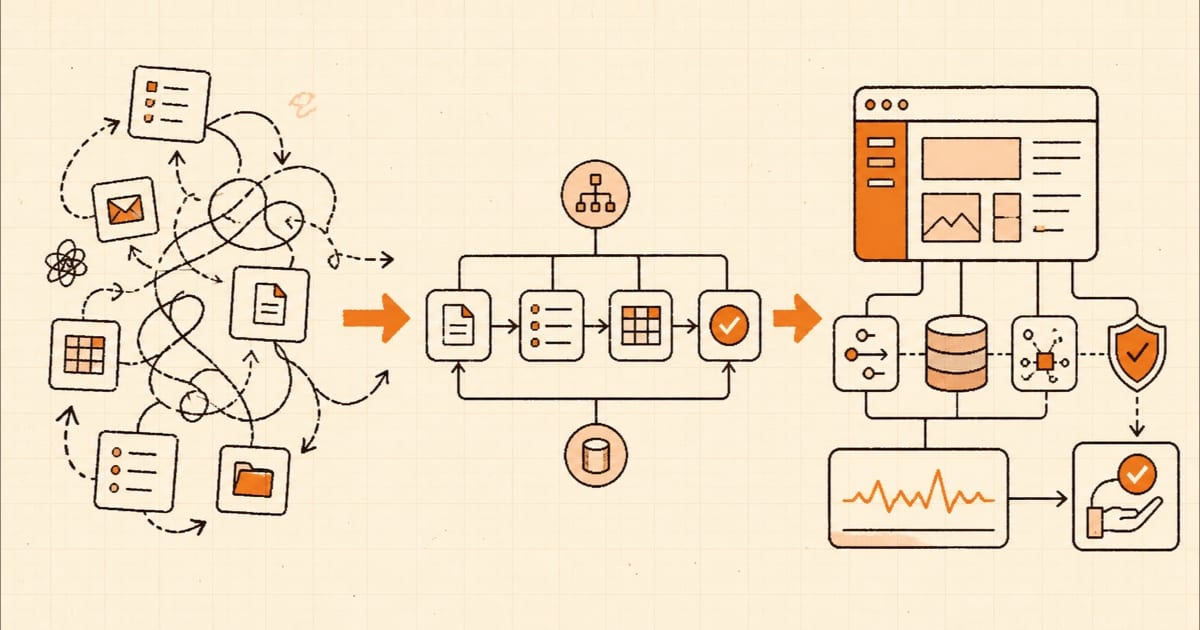
Custom AI development should not begin with a model. It should begin with a workflow: who does the work today, what information they use, where decisions happen, and what must occur when the system is uncertain.
That distinction matters. A polished demonstration can produce an impressive answer once. Production software must produce a useful outcome repeatedly, connect to the rest of the business, and fail in a controlled way.
This guide explains the decisions that turn an AI idea into software people can actually use.
When custom AI software is the right choice
Buying an existing tool is usually sensible when the workflow is standard and the available product already fits your systems. Custom development becomes useful when the valuable part of the workflow is specific to your business.
Common signals include:
- information is spread across documents, databases, inboxes, and internal tools;
- staff repeatedly move data between systems or apply the same decision process;
- the output must follow company-specific rules, permissions, or escalation paths;
- an AI feature needs to live inside an existing web product rather than in a separate chat window;
- reliability, auditability, or human approval matters more than an impressive demo.
The goal is not to add AI everywhere. It is to remove a real bottleneck without weakening the controls around it.
Start with the workflow, not the model
A useful scope describes an observable job from beginning to end. “Add an AI assistant” is too broad. “Read an incoming support request, find the relevant account and policy, draft a response, and route uncertain cases to an operator” is something a team can design and test.
Before choosing technology, document five things:
- Trigger: What starts the workflow—a form, call, email, uploaded document, scheduled job, or API event?
- Context: Which records, documents, policies, and previous actions are needed?
- Decision: What may the system decide, and what must remain with a person?
- Action: Which system should be updated when the decision is complete?
- Fallback: What happens when data is missing, tools fail, or confidence is low?
This produces a smaller and more valuable first release than beginning with a list of model features.
A useful first version completes one workflow safely. It does not try to imitate an entire department.
Build the deterministic system around the AI
The model is one component. The surrounding software makes it dependable.
A typical production system includes:
- an application or interface where users start and review work;
- authentication, permissions, and tenant boundaries;
- APIs that connect business systems;
- a database for operational state and audit history;
- retrieval for grounding responses in approved information;
- model routing and prompt versioning;
- evaluation, logging, monitoring, and alerting;
- an explicit human-handoff path.
The deterministic parts should decide what the system is allowed to access and change. The model can interpret language, extract information, rank options, or draft an output, but permissions and irreversible actions should not depend on an unconstrained answer.
Treat data readiness as product work
Many custom AI projects are limited by data organization rather than model capability.
For a retrieval-augmented generation system, uploading files is only the beginning. The team must decide how documents are split, which metadata controls access, how updates replace older information, what sources deserve priority, and how a user can inspect the evidence behind an answer.
Production retrieval may combine several methods:
- semantic embeddings for conceptual similarity;
- keyword or sparse retrieval for names, codes, and exact phrases;
- reranking when the first retrieval pass returns too much material;
- filters for organization, geography, product, date, or permission level.
The right design depends on the queries and documents—not on whichever retrieval technique is currently fashionable.
Connect to the systems where work already happens
An AI response has limited value if someone must copy it into another tool manually. Integrations turn the response into an operational result.
That can mean creating or updating a CRM record, scheduling an appointment, generating a support ticket, retrieving account information, starting an approval, or notifying a responsible person.
Each integration should define:
- what information may be read;
- what the AI may propose;
- what it may write automatically;
- which actions require confirmation;
- how retries and duplicate events are handled;
- what is recorded for later review.
These boundaries are part of the product experience, not merely backend implementation details.
Evaluate behavior before launch
Traditional tests are necessary but insufficient for AI behavior. A production evaluation set should contain realistic examples, difficult edge cases, incomplete inputs, conflicting documents, and requests the system must refuse or escalate.
Evaluation should measure outcomes such as:
- whether the correct source was retrieved;
- whether required facts were present and supported;
- whether the right business action was selected;
- whether policy and permission boundaries were respected;
- whether uncertain cases reached a person;
- whether latency and cost remain acceptable for the workflow.
Keep these cases after launch. They become regression tests whenever prompts, models, retrieval settings, or source data change.
Design human handoff as a normal path
Handoff is not an admission that the system failed. It is part of a reliable design.
The operator should receive the original request, the context the system used, actions already taken, and a clear reason for escalation. Requiring a person to reconstruct everything defeats the purpose of automation.
A well-designed handoff also creates useful feedback. Repeated escalations reveal missing documentation, weak retrieval, unclear policies, or cases that should never have been automated.
Operate the system after release
Launching is the start of the evidence-gathering phase. Monitor both software health and workflow quality.
Useful operational signals include tool failures, retrieval misses, fallback frequency, escalation reasons, response latency, model and infrastructure cost, user corrections, and completion rates for the actual business task.
Avoid optimizing a single model score while ignoring whether the workflow became faster, safer, or easier for users. The business outcome is the real product metric.
What determines custom AI development effort?
The model is rarely the largest variable. Delivery effort is usually shaped by:
- the number and condition of data sources;
- the quality and availability of existing APIs;
- authentication and permission complexity;
- the consequences of an incorrect action;
- required approval and audit flows;
- the number of interfaces and deployment environments;
- evaluation depth and ongoing operating requirements.
A short discovery phase should turn these unknowns into an architecture, a narrow first workflow, acceptance criteria, and a staged delivery plan.
A practical partner checklist
When assessing a custom AI development company, ask for answers to these questions:
- Can the team explain the workflow without talking about models first?
- Who builds the application, APIs, data layer, AI behavior, and deployment?
- How will the system be evaluated before users depend on it?
- What happens when retrieval, a model, or an external integration fails?
- Which actions require human approval?
- How are access control, audit history, and sensitive data handled?
- What will be monitored after release, and who responds when quality changes?
Strong answers should describe a system—not just a prompt.
From one workflow to a production system
The most effective custom AI projects start narrow. Choose a workflow with a clear owner, accessible data, measurable friction, and a safe fallback. Build the complete path around it. Observe real use, then expand from evidence.
Voicepls designs and ships custom software, AI workflows, integrations, retrieval systems, and production infrastructure as one engineering partner. Talk to the engineering team about the workflow you want to improve.